Run a GTD session
Run a GTD session when your Inbox list has filled up and you want it empty: Hule shows you one task at a time and asks the questions of the GTD method, from "Is it actionable?" to "Who does it, and when?". Each decision applies as soon as you confirm it, and it can't be undone from the session, so you finish with Inbox zero.
A session runs in a view of the GTD view type. It is most useful on your Inbox list, the list where you capture your tasks.
On a shared view, everyone who can open the view takes part; the person who starts the session is its facilitator, who ends it.
Before you start
You need:
- a list with tasks to sort, such as your Inbox list;
- one or two other lists where the sorted tasks will live, for example Personal and Work (Organize folders and lists).
GTD view on your Inbox list
You do this once.
In the sidebar, open the … (More actions) menu of your Inbox list and choose New view. The new view form opens.
No New view in the menu?
New view shows in a list's menu only if you may edit the list (permissions and access).
In Name, type Clarify. Create becomes available.
In Display Mode, choose GTD. The view's icon changes to the GTD icon.
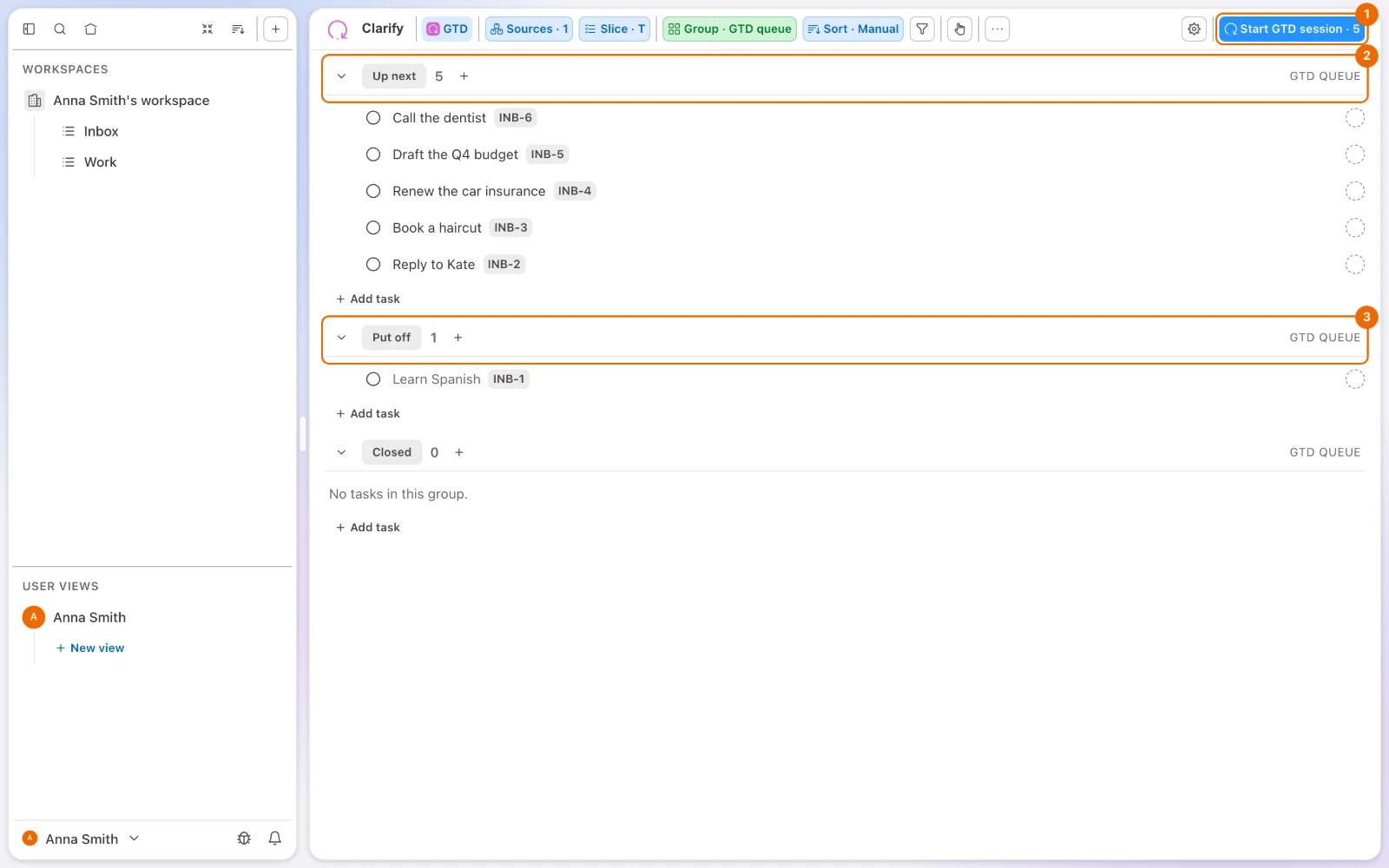
Click Create. The view opens with your tasks grouped by GTD queue (grouping); the session takes the tasks under Up next, except muted ones (see If it doesn't work). Start and due dates are shown in the task rows by default. If nothing is waiting, the view shows Inbox zero instead.
Decision path in a session
Every task takes one road through these questions. The labels on the arrows are the choices the session panel offers.
flowchart TB
  T["Task from Up next"]
  A{"Is it actionable?"}
  R["What is the desired outcome?<br/>Steps are optional"]
  W{"Who does it, and when?"}
  NOW["Two-minute timer, then Done:<br/>task closed"]
  SCH["Moved to a list, or kept with a later start;<br/>assigned to you, dates optional"]
  DEL["Moved to another list;<br/>assignee and follow-up date optional"]
  X{"Then it is…"}
  TR{"Delete it, or keep a record?"}
  KEEP["Kept under a status you pick"]
  GONE["Deleted with its history"]
  SOME["Stays in its list;<br/>back in Up next on the return day"]

  T -- "asks" --> A
  A -- "Yes, it's actionable" --> R
  R -- "Continue" --> W
  W -- "I'll do it now" --> NOW
  NOW -- "I didn't make it" --> W
  W -- "Schedule it and do it myself" --> SCH
  W -- "Delegate it" --> DEL
  A -- "No" --> X
  X -- "Trash" --> TR
  TR -- "Keep" --> KEEP
  TR -- "Delete" --> GONE
  X -- "Someday / maybe" --> SOME
After each decision, the panel opens the next task.
Clarify each task
Click Start GTD session. The button shows how many tasks are waiting. A panel opens beside the first task, with the counter … of … clarified at its bottom.
Start button greyed out?
If the view has just opened, wait for the session to load. Otherwise nothing is waiting: the view shows Inbox zero, with a hint on when put-off tasks come back. The session takes only tasks in lists you may edit (permissions and access).
Answer Is it actionable?
- Yes, it's actionable: go on to step 3.
- No: choose what it is instead (see Not actionable).
Desired outcome starts with the task's title. Change it to what will be true when it's done. It becomes the task's title.
If it takes several actions, add them under Steps — optional. Press
Enterin a step to add the next one. Each step becomes a subtask, and the panel marks the task as a Project: in GTD, an outcome that takes more than one action is a project.No Steps field?
Adding steps creates subtasks, so it needs permission to create tasks in that list (permissions and access).
Click Continue. In Desired outcome you can press
Enterinstead; in a step, pressCmd+Enter(Ctrl+Enteron Windows and Linux). The panel asks Who does it, and when?
Next action: who and when
Choose who does it and when:
Choice What it does I'll do it now Starts a two-minute timer. Click Done, and the task closes under its list's done status, assigned to you. Schedule it and do it myself Moves the task to the list you pick in Move to list, with dates in When if it has them, and assigns it to you. Delegate it Moves the task to the list you pick in Move to list. Assign to a person and set a follow-up date as the due date in When. Both are optional. The panel shows the settings for your choice.
The two-minute rule
In GTD, anything under two minutes is done at once: that is I'll do it now. If the timer runs out, click I didn't make it to choose again.
No I'll do it now?
A task with steps is a project and can't be done in two minutes; a list without a closing status can't close it (Change statuses). Choose Schedule it and do it myself.
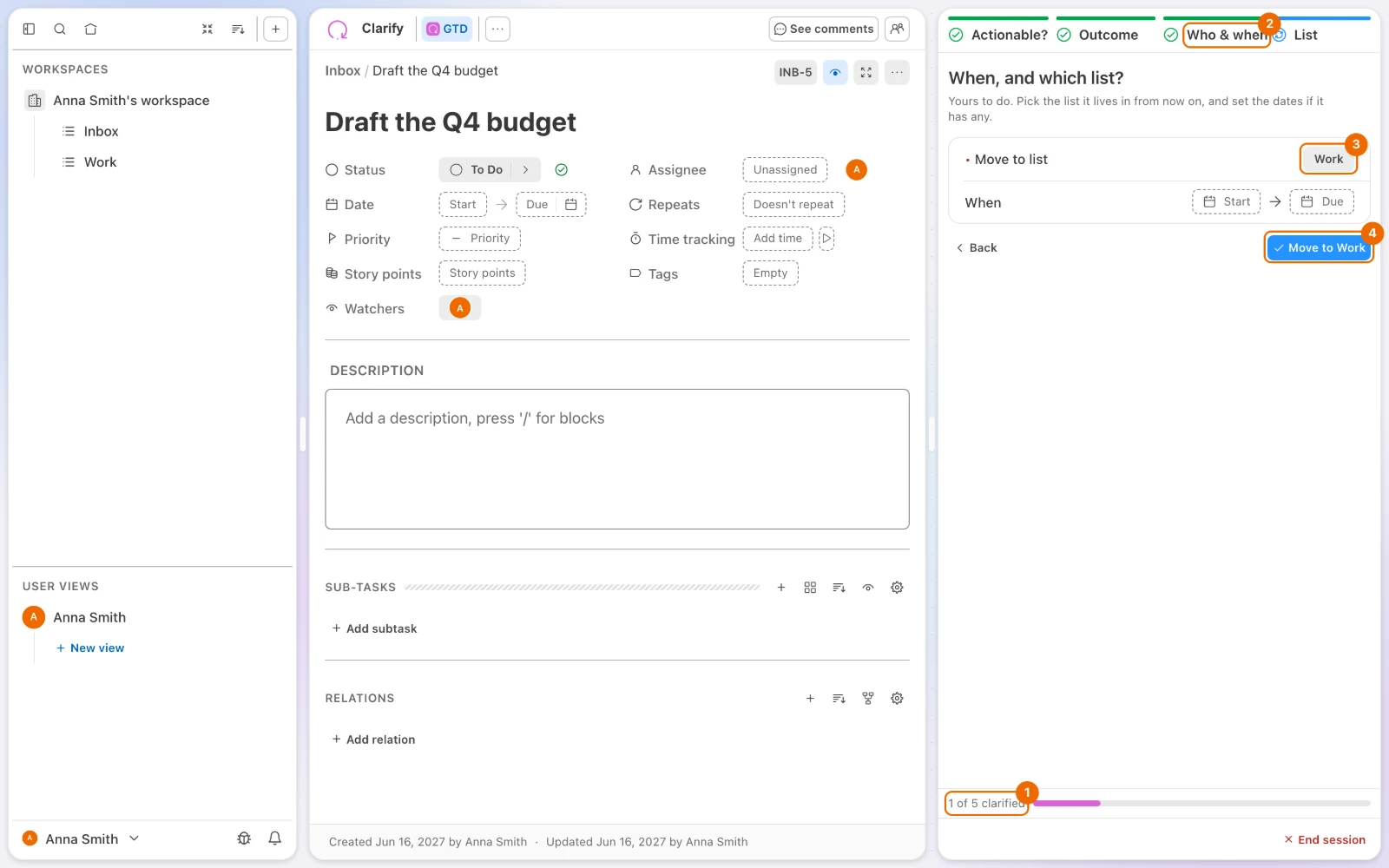
Click the confirm button, for example Move to Work. The next task opens, and the counter goes up by one. If the button says Pick another list or your list is not in Move to list, see If it doesn't work.
Not actionable: trash or someday
After you answer No to Is it actionable?, the panel asks Then it is…
Choose Trash or Someday / maybe. The panel asks Delete it, or keep a record? or When does it come back? If Someday / maybe says "This list keeps no start date", see If it doesn't work.
For Trash, choose Keep or Delete in What to do. Keep keeps the task as a record that search still finds.
Only Keep under Trash?
Delete shows only if you may delete tasks in that list (Permissions and access).
Set where it goes:
- Keep: pick the list in Where to keep it and a status in Under which status. Kept in the same list, pick a status in the Done stage, or the task comes back next session.
- Someday / maybe: Returns on starts a month from today (or on the task's due date, if that comes sooner). Change it if you like.
Click the confirm button:
- Keep: Keep as …, or Move to … when that list has no statuses;
- Delete: Delete the task;
- Someday / maybe: Put off until ….
The next task opens. A task put off stays in its list and returns to Up next on that day.
Delete can't be undone
Delete the task removes the task with its history. There is no undo.
Finish the session
When the last task is done, Inbox zero replaces the task card, and the panel lists your decisions (Decisions · …).
To hand a shared session over, click Choose facilitator (the people icon) in the view header and pick a member. They become the facilitator.
The facilitator clicks Back to the list to end the session; others see who will end it. To stop earlier, the facilitator clicks End session in the view header.
No Choose facilitator, End session or Back to the list?
Only the facilitator or a workspace admin (Permissions and access) hands a shared session over or ends it. Everyone else sees who ends it.
Your place is kept
A session survives a page reload or a closed tab: open the view again and carry on where you left off.
Five-task example session
A session over the Inbox list shown above takes the five tasks under Up next. Learn Spanish waits under Put off, so the session skips it.
| Task in the Inbox list | Your answers | Result |
|---|---|---|
| Call the dentist | Actionable → I'll do it now → Done | Closed on the spot, assigned to you |
| Draft the Q4 budget | Actionable → steps "Collect invoices", "Fill in the template" → Schedule it and do it myself, list Work, due Friday | Project in Work with 2 subtasks, assigned to you |
| Renew the car insurance | Actionable → Delegate it, list Personal, assign to Alex, follow-up Saturday | Waits in Personal, due Saturday |
| Book a haircut | Not actionable → Someday / maybe, returns in a month | Back in Up next in a month |
| Reply to Kate | Not actionable (you already called her) → Trash → Delete | Gone with its history |
If it doesn't work
Start GTD session is greyed out. Nothing in the view is waiting, because every task left is one of these:
- done;
- put off to a later day;
- in a list you may not edit (permissions and access).
If the view has just opened, wait for the session to load first. If tasks are put off, the Inbox zero hint says how many and when the next one comes back. Capture something new, or wait for that day.
Some tasks look muted. The session skips them. A task is muted when it is:
- put off to a later day;
- done;
- in a list you may not edit (permissions and access);
- a subtask shown under its parent task: the session takes the parent, not its subtasks.
Clarify the parent; its subtasks come with it. For a list you may not edit, ask for Edit access to it (permissions and access).
Someday / maybe says "This list keeps no start date". Open the list's … menu, choose Configure, then Features, and turn on Start Date (Turn features on or off). Or move the task to a list that has one.
I'll do it now is missing. The task has steps, or its list has no status that closes a task (Change statuses). Choose Schedule it and do it myself instead.
The confirm button says "Pick another list". Left in the Inbox list, the task would come back next session. Pick another list, or, to schedule the task and keep it here, a start date still to come in When. The list needs the Start Date feature (Turn features on or off).
Your list is not in Move to list. The picker offers only lists you may move tasks into (permissions and access).
Trash offers only Keep. You may not delete tasks in that list (permissions and access). Keep it under a closing status.
A task you kept with Trash is back in the next session. You kept it under an open status in the same list. Keep it under a status in the Done stage (Change statuses), or in another list.
Trash → Keep asks you to pick another list. The list has no statuses to keep the task under (Change statuses). Pick another list to keep it in.
A task you scheduled is back in Up next. You kept it in the Inbox list with a start date, and that day has come. Move it to another list if it shouldn't come back.
Related
- GTD in Hule: the five steps of the method and the feature behind each.
- Capture tasks to your Inbox list: fill the Inbox list you clarify here.
- View grouping: the GTD queue grouping and the others.
- Run a weekly review: the review that follows your sessions.